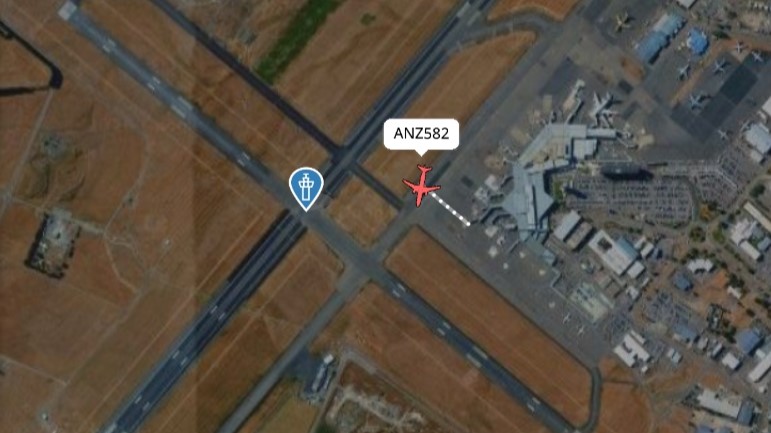
Air New Zealand passengers travelling from Christchurch to Auckland faced an early-morning disruption on Sunday after Flight NZ582 was grounded when the aircraft's main wheels rolled into grass and soft ground near a taxiway. The A320, registration ZK-OJS, had been due to depart at 5.45am. Flight-tracking information showed the aircraft was still stuck in Christchurch at 7am. The airline said the incident happened during pushback, before the aircraft had departed, and customers disembarked safely.
The operational detail is important because aircraft movements on the ground depend on tightly managed procedures, equipment and surface conditions. During pushback, the aircraft is normally moved from the gate area by a tug before taxiing under its own power. If the main wheels move off the prepared surface into soft ground, the aircraft can become difficult to move without risking damage. Air New Zealand chief safety and risk officer Nathan McGraw said the aircraft remained in place while teams worked to return it safely to the gate, unload bags and complete an engineering assessment.
For travellers, the disruption was straightforward but frustrating: a morning flight to Auckland could not leave as scheduled, and affected customers had to wait for a replacement service. The airline said it was working to put on another flight later in the morning. A passenger account described the aircraft as needing several tugs and the wheels as having sunk, illustrating why a quick fix was unlikely. Even when everyone is safe, ground incidents can take time because crews must protect passengers, staff, aircraft structure and airport operations.
The incident also shows how a single aircraft problem can ripple through the domestic network. Christchurch and Auckland are two of the country's key aviation nodes, and early flights often carry business travellers, connecting passengers and people moving between family or work commitments. If an aircraft is taken out of service for inspection, the airline has to find capacity, crew, gates and baggage handling within a schedule that is already planned tightly. In winter, weather and ground conditions can add another layer of uncertainty.
Christchurch Airport referred questions to Air New Zealand, which is standard when an airline aircraft is involved and the issue relates to its operation. Passengers will still judge the response by communication, rebooking speed and whether baggage and onward connections are handled cleanly. The safety-first approach can be inconvenient, but it is central to aviation reliability. An engineering assessment after wheels enter soft ground is not optional housekeeping; it is part of confirming that the aircraft can return to service safely.
For the wider travelling public, the lesson is not that flying has suddenly become unsafe. It is that much of air travel's reliability depends on routine ground procedures that only become visible when something goes wrong. A plane stuck beside a taxiway is a small incident compared with an airborne emergency, but it can still disrupt hundreds of plans. Air New Zealand's immediate task is to recover customers. Its longer task is to review how the aircraft left the paved surface and what, if anything, should change at the gate, tug or taxiway level.