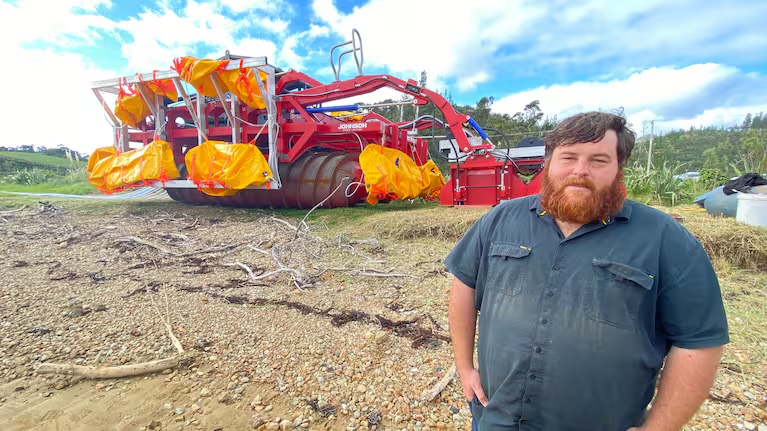
A Bay of Islands engineering story has become a national business story after Opua designer Andrew Johnson and Johnson Bros launched a $5 million underwater machine built to tackle exotic caulerpa at scale. The remote submersible dredge planer was put through final sea trials at Omakiwi Cove after four years of work linked to New Zealand's fight against the invasive seaweed. The machine was designed for a specific local problem, but the result is much bigger than a local engineering job. It shows how a small marine contractor can turn a biosecurity emergency into a piece of specialist technology that officials say could change how large infestations are handled.
The vehicle is tethered to a surface barge and operated remotely, allowing crews to remove dense caulerpa without putting divers on the seafloor for the heavy work. The final prototype is bright red, weighs about 16 tonnes and uses rotating steel Archimedes screws to move across soft seabed. Its working head shaves the plant, its runners and a thin layer of sediment, then sends the material to the barge where water and sand can be separated before the seaweed is taken ashore. That detail matters because caulerpa is not a tidy weed that can simply be pulled out once it appears. It can form thick underwater meadows and spread through fragments, changing boating, fishing and marine life in places that rely on clean harbours and public access.
Omakiwi Cove became a key test site after exotic caulerpa was confirmed there in 2023. Since then, agencies and local communities have had to weigh urgency, cost and environmental disturbance. Johnson's contribution is the founder-focused part of the story. The machine came from an Opua-based marine contractor and engineering business rather than a global defence or oilfield company. Johnson Bros developed the equipment under a regional council project funded through Biosecurity New Zealand. Johnson's view is that building the same kind of machine elsewhere could have cost far more. Whether that comparison is exact or illustrative, the core point is clear: New Zealand has produced a practical, locally built response to a marine pest that has already changed behaviour in northern waters.
The machine is not a guarantee of eradication. Environmental monitoring is still part of the trials, and biosecurity managers will need to see how the system performs across different seabed conditions and regrowth patterns. But it moves the response from hand-guided removal and smaller mechanical trials toward a tool with industrial scale. Earlier diver-led work removed only a small area compared with the new prototype's intended daily capacity. For businesses around the Bay of Islands, the issue is also economic. Boat operators, fishers, tourism providers and coastal communities all depend on confidence that pest incursions can be contained.
A tool built in Northland for a Northland problem gives those communities a stronger local stake in the solution. It also puts a spotlight on the kind of technical capability that can sit inside regional firms, often unnoticed until a crisis demands it. The next test is operational rather than symbolic. If the machine can repeatedly clear dense patches while limiting unwanted disturbance, it could become part of a wider New Zealand playbook for invasive marine species. If it needs redesign, the knowledge still stays close to the water and the people most affected. Either way, Andrew Johnson and Johnson Bros have turned the caulerpa response into one of the more concrete examples of New Zealand innovation this winter.